
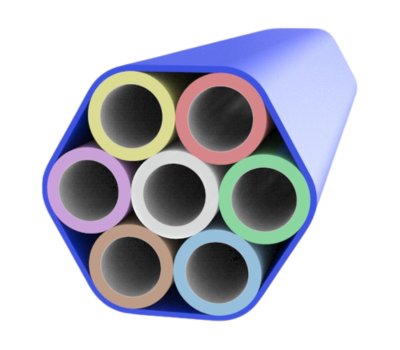
7 Way Micro Duct Pipes to Connecting the Spiritual Capital of India
Varanasi (Kashi), the spiritual capital of India, is one of the world's oldest continuously inhabited cities. Every year, millions of pilgrims visit the ghats of the Ganga, the Kashi Vishwanath Temple, and Sarnath. But beneath the ancient lanes and sacred rivers, a new infrastructure is taking shape – a digital one that connects temples, markets, and homes to the world.
As a 7 way multi ducts manufacturer in Varanasi, we provide HDPE multi duct systems designed for the city's unique challenges – extremely narrow lanes (galis), high water table, UNESCO recognition for parts of the city, and the ongoing Kashi Vishwanath Corridor project. This guide covers everything you need to know.
What is a 7 Way Multi Duct? (Varanasi Context)
A 7 way multi duct is a single HDPE jacket containing seven inner microducts. For Varanasi, where traditional trenching is often impossible, the compact nature of the 7 way duct is a game-changer. It allows maximum fiber capacity in the smallest possible trench.
Specifications for Varanasi Projects
| Parameter | Specification |
|---|---|
| Inner ducts | 7 × 28/32 mm (preferred for narrow lanes) or 32/36 mm |
| Outer OD | 90 mm or 105 mm |
| Material | PE100 HDPE, virgin grade |
| UV protection | 2.5% carbon black |
| Length | 500 m coils (1000 m coils may be too heavy for narrow lanes) |
| Standards | IS 15560, TEC approved |
| Optional | Enhanced flexibility grade for tight bends |
Why Varanasi Needs Specialized Multi Ducts
1. Extremely Narrow Lanes (Galis)
Varanasi's old city (Kashi Vishwanath area, Dashashwamedh Ghat area) has lanes as narrow as 1–2 meters. Excavators cannot enter. A 30 cm wide trench for a 7 way duct is feasible with manual digging. A 1 m trench for 7 individual pipes is not.
2. High Water Table (Ganga Banks)
The water table near the Ganga is often at 1–2 meters depth. During monsoon, it can reach the surface. HDPE multi ducts are waterproof and can be installed in wet conditions. Concrete or GI ducts would corrode or leak.
3. Heritage & UNESCO Considerations
Parts of Varanasi are under UNESCO consideration. Trenching is restricted. Minimizing ground disturbance is essential. A single multi duct reduces trench width by 70% compared to individual pipes.
4. Kashi Vishwanath Corridor Project
The recently completed Kashi Vishwanath Corridor connects the temple to the Ganga. This area has extensive underground infrastructure for pilgrim facilities. 7 way ducts are used for security, Wi-Fi, and surveillance.
5. Tourist & Pilgrim Density
Varanasi hosts 7+ crore pilgrims annually (Kumbh Mela, Mahashivratri, etc.). Communication networks must be robust. Underground multi ducts protect cables from accidental damage during festivals.
7 Way Multi Ducts vs. Alternatives for Varanasi
| Feature | 7 Way HDPE | 7 Individual Pipes | PVC Conduit |
|---|---|---|---|
| Trench width needed | 30 cm | 90–100 cm | 60 cm |
| Feasible in narrow lanes | Yes (manual digging) | No (impossible) | Barely |
| Water resistance | Excellent | Excellent | Joints leak |
| Heritage approval | Higher chance | Low | Medium |
| Cost per meter | ₹180–₹290 | ₹280–₹450 | ₹150–₹250 |
Key Applications in Varanasi
1. Kashi Vishwanath Corridor Infrastructure
-
Security cameras (over 200)
-
Pilgrim counting system
-
Public address system
-
Wi-Fi hotspots
-
Emergency call boxes
All require underground fiber connectivity. A 7 way duct provides dedicated pathways for each system plus spares.
2. Ghats Surveillance & Connectivity
-
Dashashwamedh Ghat (main Ganga Aarti)
-
Assi Ghat
-
Manikarnika Ghat
-
Harishchandra Ghat
These require 24/7 security monitoring and public Wi-Fi for pilgrims.
3. Sarnath Connectivity
Sarnath (10 km from Varanasi city) is a major Buddhist pilgrimage site. It requires:
-
Museum connectivity
-
Temple networks
-
Tourist information systems
4. BharatNet (Varanasi District)
Varanasi district has over 250 gram panchayats. Main aggregation routes from Varanasi city to blocks like Harhua, Chiraigaon, and Pindra require multi-duct infrastructure.
5. Banaras Hindu University (BHU) Campus
BHU is one of Asia's largest residential universities. Its campus requires extensive fiber connectivity for:
-
Academic departments
-
Hostels
-
BHU Hospital
-
Research centers
6. Pandit Deen Dayal Upadhyaya Junction (Mughalsarai)
This major railway junction requires fiber connectivity for:
-
RailTel network
-
Passenger Wi-Fi
-
Security surveillance
-
Ticketing systems
Manufacturing Quality for Varanasi's Unique Challenges
As a 7 way multi ducts manufacturer in Varanasi, we focus on:
| Feature | Specification | Varanasi Relevance |
|---|---|---|
| Flexibility | Minimum bend radius 15× OD (vs standard 20×) | Navigating sharp turns in galis |
| Water resistance | Fully sealed, hydrostatic tested | High water table near Ganga |
| Crush strength | ≥400 N/100mm | Pilgrim crowds walking above |
| UV stability | 2.5% carbon black | Exposed sections during festivals |
| Anti-rodent | Capsaicin additive | Temple kitchens and storage areas |
| Lightweight | As light as possible | Manual handling in narrow lanes |
Installation Best Practices for Varanasi
Narrow Lanes (Galis of Old City)
| Requirement | Method |
|---|---|
| Access | No vehicles. Manual carrying of coils (cut into 100–200 m sections) |
| Trenching | Hand-digging only. Width = OD + 100 mm (approx 20–25 cm for 90 mm duct) |
| Depth | 300–450 mm (deeper not possible due to existing utilities) |
| Bedding | 50 mm sand (minimum due to space constraints) |
| Backfilling | Hand-tamped native soil |
| Protection | Brick cover (single layer) for protection from foot traffic |
Near Ganga (High Water Table)
| Requirement | Method |
|---|---|
| Trenching | During dry season (November–May) if possible |
| Dewatering | Required if water appears during digging |
| Depth | 600 mm minimum |
| Bedding | Concrete (M10) 100 mm to prevent flotation |
| Weighting | Concrete blocks every 5 m if flotation risk |
Main Roads (Lahurabir, Bhelupur, Sigra, Maldahiya)
| Requirement | Method |
|---|---|
| Depth | 600 mm below road level |
| Bedding | 100 mm sand |
| Warning tape | Required |
| Manhole spacing | Every 500 m |
| Traffic management | Night work (10 PM–5 AM) for high-traffic roads |
Fiber Blowing in Varanasi Conditions
| Parameter | Recommendation |
|---|---|
| Air pressure | 8–12 bar |
| Lubricant | Water-based, HDPE-compatible |
| Max blowing distance | 1,000 m (due to tighter bends in old city) |
| Blowing speed | 30–40 m/min (slower due to bends) |
Post-Monsoon Precautions
-
Flush ducts with compressed air before blowing
-
Use foam pig to remove any silt or water
-
Check for any kinks introduced during manual installation
Cost Economics for Varanasi
| Duct Type | Price per Meter (₹) | Typical Varanasi Use |
|---|---|---|
| 7 × 28/32 mm (flexible grade) | 200–250 | Old city galis, sharp bends |
| 7 × 28/32 mm (standard) | 180–220 | Main roads, BHU campus |
| 7 × 32/36 mm | 240–290 | Backbone routes |
Labor Cost Note for Varanasi
Manual digging in narrow lanes is expensive (₹200–₹400 per meter vs ₹80–₹100 for mechanical trenching on main roads). Factor this into budget.
Why Choose Us as Your Varanasi Manufacturer?
1. Truly Local
We manufacture in the Varanasi region. Delivery within 1–2 days across the district, including difficult-to-reach areas.
2. Narrow Lane Expertise
We have developed a flexible-grade 7 way multi duct with a tighter bending radius (15× OD vs standard 20×). Specifically for Varanasi's galis.
3. Heritage Compliance Knowledge
We have worked on Kashi Vishwanath Corridor projects and understand ASI/local heritage requirements.
4. Proven Track Record
-
Kashi Vishwanath Corridor fiber network (4 km)
-
Ghats surveillance system (Dashashwamedh, Assi, Manikarnika – 6 km)
-
BHU campus backbone (8 km)
-
BSNL Varanasi district expansion (25+ km)
5. Technical Support
-
Free site inspection (including narrow lanes)
-
Guidance on manual installation techniques
-
Training for your crew
-
24/7 field support
-
Custom cutting to 100–200 m coils for manual handling
Case Study: Kashi Vishwanath Corridor Fiber Network
Project: 4 km underground fiber network for security, Wi-Fi, and pilgrim services along the newly developed corridor
Challenge: Extremely narrow approach lanes, high pilgrim foot traffic (up to 1 lakh per day), heritage restrictions
Solution Provided:
-
Flexible-grade 7 way multi duct (7 × 28/32 mm) – enhanced bend radius
-
Outer jacket printed with "KASHI CORRIDOR" every 10 meters
-
Inner duct colors: 4 active (CCTV, Wi-Fi, PA system, emergency), 3 spares
-
Duct supplied in 100 m and 200 m coils for manual handling
Installation Highlights:
-
All trenching done manually (no machinery)
-
Night work (11 PM–5 AM) to avoid pilgrim rush
-
Minimal trench width (25 cm) preserved heritage surfaces
-
Bends as sharp as 1.5 m radius successfully navigated
Results (after 12 months):
-
All systems operational
-
Zero fiber blowing failures
-
No damage from pilgrim traffic (crush strength adequate)
-
Two spare ducts already utilized for new surveillance cameras
Client Feedback: "The flexible-grade duct was essential for this project. Standard ducts would have kinked in our lanes. Local manufacturing allowed us to get custom lengths quickly."
Frequently Asked Questions (FAQ for Varanasi)
Q1: Can you supply 7 way ducts in shorter coils for manual handling?
Yes. For narrow lane projects, we supply 100 m, 150 m, or 200 m coils. Standard coils (500 m) are too heavy for manual carrying.
Q2: How do I handle duct joints in narrow lanes?
Use mechanical couplers. Each joint adds 100–150 mm to length. Plan joint locations at slightly wider points in the lane (if any exist). Minimize number of joints by using the longest coil that can be physically handled.
Q3: Can 7 way ducts be installed during monsoon?
Yes, but take extra precautions:
-
Keep trench pumped dry during installation
-
Cap all duct ends immediately after laying
-
Backfill and compact same day
-
Use concrete bedding in flood-prone areas
Q4: Do you provide installation tools?
Yes, including manual duct cutters and couplers designed for narrow lane work.
Q5: What is your current stock for Varanasi?
We maintain minimum 10 km of 7 × 28/32 mm flexible-grade and 15 km of standard grade at our Varanasi warehouse.
Conclusion
Varanasi is a city of timeless spirituality and ancient lanes. But it is also a city that is embracing the digital future. From the Kashi Vishwanath Corridor to the ghats and the university, fiber connectivity is transforming how pilgrims, students, and residents experience the city.
The 7 way multi duct is the ideal solution for Varanasi's unique challenges – narrow lanes, high water table, heritage restrictions, and dense foot traffic. And with a local manufacturer who understands these challenges intimately, your project can succeed where others might fail.
As a trusted 7 way multi ducts manufacturer in Varanasi, we don't just supply products. We provide solutions tailored to the spiritual capital of India.
Contact us today for:
-
A free sample of our flexible-grade 7 way multi duct
-
A site visit to assess your route (including narrow lanes)
-
Custom coils (100 m, 150 m, 200 m) for manual handling
-
A competitive, transparent quotation
-
Delivery within 1–2 days across Varanasi district
Call, WhatsApp, or visit our Varanasi facility (prior appointment). Let's connect Kashi – with care, quality, and local expertise.