
HDPE Pipe for Water Supply – What You Need to Know Before You Buy
Water supply systems are the lifeline of any community. And at the heart of every good system? A reliable pipe.
If you've been researching options, you've probably come across HDPE pipes. They're everywhere these days and for good reason. But before you make a choice, it helps to understand what makes a good hdpe pipe for water supply and what to look for when buying one.
Let's walk through it together simply and clearly.
First Things First – The Standard That Matters
 In India, if you're buying pipes for drinking water, there's one number you should know: IS 4984.
This is the official Bureau of Indian Standards (BIS) specification that governs hdpe pipes for water supply is 4984. It ensures that the pipe you're getting is safe, strong, and suitable for carrying potable water.
So whenever someone asks, "Is this pipe safe for drinking water?" checking for IS 4984 compliance is your first answer.
What Grade of Material Should You Look For?
Not all HDPE is created equal.
The latest IS 4984 standard requires pipes to be made from PE 80 or PE 100 virgin-grade compounds. These are the good ones stronger, more durable, and longer-lasting.
You might hear about PE 63 sometimes, but honestly? It's outdated and phased out in the current revision. So if you're choosing a polyethylene pipe for water supply, always go for PE 80 or PE 100. They handle pressure better and last longer especially underground.
Sizes and Pressure Ratings – What Do They Mean?
A pe pipe for water supply comes in a wide range of sizes starting from as small as 16 mm all the way up to over 1200 mm in diameter. Whether you're laying a small household line or a city-wide main, there's a size for every need.
But size alone isn't enough. You also need to think about pressure.
Pipes are rated from PN 2.5 (which handles 2.5 kg/cm²) to PN 16 (which handles 16 kg/cm²). In simple terms:
-
Lower PN ratings = for low-pressure applications like gravity-fed systems
-
Higher PN ratings = for high-pressure mainlines or hilly terrains
Choosing the right hdpe pipe for water supply specifications means matching the pipe's pressure rating to your actual system needs nothing more, nothing less.
How to Spot a Drinking Water Pipe
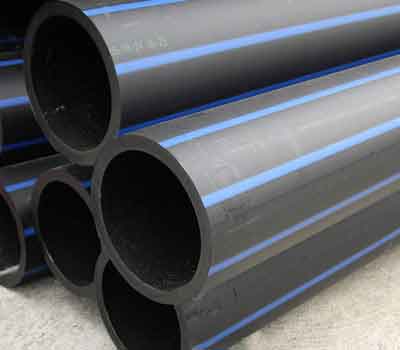
Here's a quick visual trick: if you're looking at a poly pipe for water supply meant for drinking water, it will usually be black with co-extruded blue stripes.
That's not just for decoration. Those blue stripes are a universal identifier they tell you at a glance that this pipe is safe for potable water. So if you see blue stripes, you know it's a drinking water pipe. Simple, right?
Sizes and Pressure Ratings – What Do They Mean?
A pe pipe for water supply comes in a wide range of sizes starting from as small as 16 mm all the way up to over 1200 mm in diameter. Whether you're laying a small household line or a city-wide main, there's a size for every need.
But size alone isn't enough. You also need to think about pressure.
Pipes are rated from PN 2.5 (which handles 2.5 kg/cm²) to PN 16 (which handles 16 kg/cm²). In simple terms:
-
Lower PN ratings = for low-pressure applications like gravity-fed systems
-
Higher PN ratings = for high-pressure mainlines or hilly terrains
Choosing the right hdpe pipe for water supply specifications means matching the pipe's pressure rating to your actual system needs nothing more, nothing less.
Above Ground or Underground – It Works Both Ways
Whether you're laying pipes above ground or burying them deep underground, HDPE performs beautifully.
-
Above ground: It resists UV damage and temperature changes, so it doesn't weaken or crack in the sun.
-
Underground: Its flexibility allows it to handle soil shifts and heavy loads without breaking. The joints are fused together to become one seamless piece so no leaks, no contamination, no wasted water.
That's why so many projects from rural drinking water schemes to urban distribution networks trust HDPE.
What to Look for in a Manufacturer
When you're investing in a water supply system, the pipe manufacturer matters just as much as the pipe itself.
Look for someone who:
-
Follows IS 4984 standards strictly
-
Uses PE 80 or PE 100 virgin material
-
Has the capacity to produce pipes in the size and pressure rating you need
-
Offers certified, tested products
That's where Berlia Pipes comes in. They manufacture HDPE pipes with government of India recognized certifications, using the latest machinery to produce sizes up to 1200 mm in diameter. And with a focus on fast turnaround times, they ensure your project doesn't get stuck waiting for materials.
The Simple Takeaway
Choosing an hdpe pipe for water supply doesn't have to be complicated.
-
Look for IS 4984 compliance
-
Choose PE 80 or PE 100 material
-
Match the pressure rating to your needs
-
Spot the blue stripes for drinking water safety
-
And pick a manufacturer you can trust
Do that, and you're well on your way to building a water supply system that's safe, strong, and built to last.