
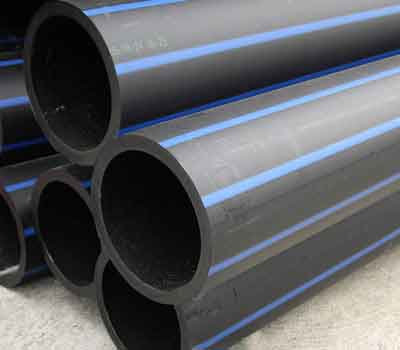
1200 mm High-Density Polyethylene (HDPE) pipes Manufacturer
When infrastructure projects demand the movement of colossal volumes of water – think millions of liters per hour – standard pipe diameters simply do not suffice. Enter the 1200 mm High-Density Polyethylene (HDPE) pipe. At 1.2 meters in diameter, this is not a pipe for a residential connection or a small industrial line. This is a pipeline for cities, power plants, major irrigation schemes, and large-scale industrial complexes.
As a specialized 1200 mm HDPE pipes manufacturer, we have engineered, produced, and supplied these giants for some of India's most demanding projects. In this comprehensive guide, we will explore the technical specifications, applications, manufacturing challenges, installation requirements, and cost considerations of 1200 mm HDPE pipes. We will also explain why HDPE outperforms traditional materials like concrete, mild steel, and ductile iron at this diameter.
What is a 1200 mm HDPE Pipe?
A 1200 mm HDPE pipe refers to a pipe with a nominal outside diameter (OD) of 1200 millimeters (1.2 meters). These pipes are produced by extrusion of high-density polyethylene resin, typically PE100 grade, which offers superior long-term strength and resistance to slow crack growth.
Key Technical Specifications
| Parameter | Typical Range |
|---|---|
| Outside diameter (OD) | 1200 mm ± 1% |
| Inside diameter (ID) | Varies by SDR (e.g., SDR 17: ~1060 mm ID) |
| Standard Dimension Ratio (SDR) | SDR 11, 13.6, 17, 21, 26, 33, 41 |
| Pressure rating (PN) | PN6 (SDR 26), PN10 (SDR 17), PN12.5 (SDR 13.6), PN16 (SDR 11) |
| Material grade | PE100 (ISO 4427) or PE80 (less common) |
| Standard length | 6 m, 10 m, 12 m (custom lengths possible) |
| Color | Black with blue stripes (water), solid black (sewage/gas), yellow (gas) |
| Wall thickness (example) | SDR 17: 70.6 mm; SDR 11: 109.1 mm |
| Weight per meter (approx.) | SDR 17: ~100 kg/m; SDR 11: ~150 kg/m |
| Manufacturing standards | ISO 4427, ASTM F714, IS 4984, IS 14333 |
Understanding SDR and Pressure Rating
SDR (Standard Dimension Ratio) = OD ÷ wall thickness. A lower SDR means a thicker wall and higher pressure rating.
| SDR | Wall Thickness (1200 mm OD) | PN Rating (PE100) | Typical Application |
|---|---|---|---|
| SDR 41 | 29.3 mm | PN 4 | Gravity sewers, stormwater |
| SDR 33 | 36.4 mm | PN 5 | Large diameter drainage |
| SDR 26 | 46.2 mm | PN 6 | Cooling water intakes |
| SDR 21 | 57.1 mm | PN 8 | Raw water transmission |
| SDR 17 | 70.6 mm | PN 10 | Municipal water mains |
| SDR 13.6 | 88.2 mm | PN 12.5 | Industrial process water |
| SDR 11 | 109.1 mm | PN 16 | High-pressure force mains |
Critical Applications of 1200 mm HDPE Pipes
1. Municipal Water Transmission Mains
Large cities require primary water feeders from treatment plants to storage reservoirs. A 1200 mm HDPE pipe at 1.5 m/s flow velocity can carry approximately 1,700 liters per second (over 6 million liters per hour). For a city of 1 million people, two such pipes are typically sufficient.
2. Raw Water Intake Lines
Power plants, refineries, and large industrial complexes draw cooling water from rivers, lakes, or the sea. 1200 mm HDPE pipes are ideal for:
-
Submerged intakes (resistant to salt water)
-
Floating intake lines (HDPE floats naturally when empty)
-
Buried intake pipelines
3. Major Irrigation Schemes
Under the Pradhan Mantri Krishi Sinchayee Yojana (PMKSY), large-diameter HDPE pipes are increasingly replacing open canals. Benefits include:
-
Zero water loss due to seepage (canals lose 30–40%)
-
No evaporation (buried pipes)
-
Ability to cross valleys and ridges without aqueducts
4. Sewage Force Mains
When treatment plants are located away from collection networks, sewage must be pumped. 1200 mm force mains are used for large catchment areas. HDPE's resistance to hydrogen sulfide (H₂S) corrosion is unmatched.
5. Stormwater Drainage for Airports & Industrial Estates
Major airports (including Patna's Jay Prakash Narayan Airport expansion) and large industrial estates use 1200 mm HDPE for stormwater to handle 100-year flood events.
6. Dredging & Slurry Lines
Mining and dredging operations require pipes that can withstand abrasive slurries. HDPE's abrasion resistance is 4× better than steel for sand and slurry transport.
1200 mm HDPE vs. Traditional Materials
This is where HDPE truly shines. At 1.2 meters diameter, traditional materials become exponentially heavier and more difficult to install.
| Feature | 1200 mm HDPE (SDR 17) | 1200 mm Concrete (NP4) | 1200 mm Ductile Iron | 1200 mm Mild Steel |
|---|---|---|---|---|
| Weight per 6m pipe | ~600 kg | ~5,000 kg | ~3,600 kg | ~4,200 kg |
| Joint type | Butt fusion (leak-proof) | O-ring (potential leak) | Gasketed push-on | Welded (requires skilled welders) |
| Corrosion resistance | Excellent (immune) | Poor (rebar rusts) | Moderate (needs lining) | Poor (needs coating + CP) |
| Flexibility | High (survives settlement) | Rigid (cracks under settlement) | Moderate | Rigid |
| Hydraulic roughness (C-factor) | 150 (smooth) | 120–130 | 130–140 | 120 (rusts over time) |
| Installation crew size | 4–6 persons | 10–15 persons | 8–12 persons | 8–10 persons |
| 50-year life cycle cost | Lowest | High (repairs, leaks) | Medium-high | Very high (corrosion) |
| Ability to withstand water hammer | Excellent (ductile) | Poor (cracks) | Good | Fair |
Detailed Comparison: HDPE vs. Concrete
Concrete pipes at 1200 mm diameter are extremely heavy (5–6 tons per 2.5 m length). They require heavy cranes and careful handling. More importantly:
-
Concrete is porous – roots infiltrate joints
-
Concrete cracks under soil settlement
-
Concrete spalls (surface flakes off) in acidic or saline soils
-
Repairing a 1200 mm concrete pipe requires excavation of the entire section
HDPE solves all these problems – it is lightweight, flexible, corrosion-proof, and can be repaired via fusion welding of a patch.
Detailed Comparison: HDPE vs. Mild Steel
Mild steel pipes require:
-
External coating (bitumen, epoxy, or PE tape) – which can be damaged during installation
-
Cathodic protection (sacrificial anodes or impressed current) – ongoing maintenance cost
-
Internal lining (cement mortar or epoxy) to prevent rust contamination of water
-
Skilled welders for joints (X-ray inspection often required)
For a 10 km pipeline, the maintenance cost difference between HDPE and steel over 50 years is in the crores (tens of millions of rupees).
Manufacturing Challenges for 1200 mm HDPE Pipes
Producing 1.2-meter diameter HDPE pipes is not the same as making 110 mm pipes. Specialized equipment and quality control are essential.
1. Extrusion Line Requirements
-
Extruder: Minimum 250 kW motor, 150 mm screw diameter
-
Die head: Spiral or spider type for large diameters
-
Vacuum calibration tank: 8–10 meters long to cool and size the pipe
-
Haul-off: Caterpillar type with 12–16 tracks
-
Cooling bath: 20–30 meters total length
2. Raw Material Consumption
A 1200 mm SDR 17 pipe (70.6 mm wall thickness) consumes approximately 100 kg of HDPE resin per linear meter. For a 1 km pipeline: 100 metric tons of resin.
3. Quality Control Challenges
-
Ovality: Large pipes tend to go out-of-round during cooling. We use internal air pressure and external vacuum calibration to maintain <3% ovality.
-
Wall thickness concentricity: Ultrasonic sensors continuously scan the circumference.
-
Internal surface finish: Any roughness affects fiber blowing (for duct applications) or flow efficiency.
4. Common Manufacturing Defects to Avoid
| Defect | Cause | Prevention |
|---|---|---|
| Ovality >5% | Uneven cooling | Ensure cooling bath water flows uniformly |
| Thick/thin spots | Die misalignment | Regular die centering checks |
| Melt fracture (rough surface) | Excessive extrusion speed | Reduce line speed; check melt temperature |
| Black specks (burnt resin) | Degradation in extruder | Clean extruder; lower temperature profile |
| Poor fusion bead formation (for butt fusion) | Incorrect facing/cooling time | Train operators; use fusion log sheets |
Installation Best Practices for 1200 mm HDPE Pipes
Installing 1.2-meter diameter pipes requires planning, heavy equipment, and adherence to manufacturer guidelines.
Trench Design & Preparation
| Parameter | Requirement |
|---|---|
| Minimum trench width | OD + 600 mm (1.8 m for 1200 mm pipe) |
| Standard trench width | OD + 1,000 mm (2.2 m) for working space |
| Depth to top of pipe | Minimum 1,000 mm below road surface |
| Bedding thickness | 200 mm of compacted sand or fine gravel (no stones >10 mm) |
| Bedding material | Coarse sand (Zone II or III), maximum particle size 10 mm |
Handling & Lifting
-
NEVER use chains – they gouge HDPE. Use nylon or polyester slings (minimum 5 tons capacity).
-
Lifting points: Two slings for a 6 m pipe, three slings for a 12 m pipe.
-
Unloading: Use forklifts with padded forks or cranes with spreader beams.
Butt Fusion for 1200 mm Pipes
Butt fusion is the only reliable joining method for 1200 mm HDPE. Electrofusion fittings at this size are extremely expensive and rarely used.
Equipment required:
-
Hydraulic butt fusion machine with minimum 10–15 ton pull force
-
Facer (planer) with 1200 mm capacity
-
Heater plate (temperature controlled to 205–215°C)
-
Clamping assemblies for large diameters
Fusion parameters (typical for PE100, SDR 17):
| Parameter | Value |
|---|---|
| Heater plate temperature | 210°C ± 5°C |
| Bead-up pressure (drag) | 0.15–0.20 N/mm² |
| Bead-up soak time | 60–90 seconds |
| Fusion pressure (heat soak) | 0.01–0.05 N/mm² |
| Heating time | 15–25 minutes (depending on wall thickness) |
| Changeover time (heater removal to joining) | <60 seconds |
| Cooling time under pressure | 45–90 minutes |
| Total cycle time per joint | 2–3 hours |
Critical quality checks after fusion:
-
Bead size must be uniform around circumference (±20%)
-
Bead height should be approximately 30% of wall thickness
-
No voids, discoloration, or cold cracks
Lowering into Trench
For 1200 mm pipes, do not drop or roll the pipe into the trench. Use:
-
Side boom (pipelayer) for large projects
-
Multiple slings with equal-length legs
-
Guide ropes to control swing
Backfilling
| Layer | Material | Thickness | Compaction |
|---|---|---|---|
| 1 (bedding) | Sand | 200 mm | Hand or light mechanical |
| 2 (pipe surround) | Sand | 300 mm above pipe | Hand-tamped |
| 3 (warning) | Sand + detectable tape | 150 mm | Light mechanical |
| 4 (primary backfill) | Native soil (no rocks >50 mm) | To surface | Mechanical, avoid direct pipe contact |
NEVER use vibratory rollers directly above the pipe. Maintain at least 500 mm cover before vibratory compaction.
Hydrostatic Testing of 1200 mm HDPE Pipelines
Before commissioning, every HDPE pipeline must be pressure tested.
Testing Protocol
| Parameter | Requirement |
|---|---|
| Test medium | Clean water (not air – air is compressible and dangerous) |
| Test pressure | 1.5 × maximum operating pressure (e.g., 15 bar for PN10 pipe) |
| Test duration | Minimum 4 hours for pipelines <5 km; 24 hours for longer pipelines |
| Pressure gauge accuracy | ±1% of full scale |
| Temperature compensation | Correct for water temperature changes during test |
Acceptance Criteria
-
No visible leakage at joints or fittings
-
Pressure drop <2% of test pressure over 4 hours (excluding temperature effects)
Safety Warning for 1200 mm Testing
The stored energy in a 1.2-meter pipe at 15 bar is enormous. A failure can be catastrophic. Always:
-
Use slow pressurization (0.5 bar/minute)
-
Keep personnel away during test (minimum 100 m exclusion zone)
-
Use pressure relief valves
Cost Considerations for 1200 mm HDPE Pipes
Indicative Pricing (Ex-factory, Indian Rupees)
| SDR | PN Rating | Approximate Price per Meter (₹) | Price per 12m Pipe (₹) |
|---|---|---|---|
| SDR 41 (29.3 mm wall) | PN 4 | ₹8,000 – ₹10,000 | ₹96,000 – ₹1,20,000 |
| SDR 33 (36.4 mm wall) | PN 5 | ₹10,000 – ₹12,000 | ₹1,20,000 – ₹1,44,000 |
| SDR 26 (46.2 mm wall) | PN 6 | ₹12,000 – ₹15,000 | ₹1,44,000 – ₹1,80,000 |
| SDR 21 (57.1 mm wall) | PN 8 | ₹15,000 – ₹18,000 | ₹1,80,000 – ₹2,16,000 |
| SDR 17 (70.6 mm wall) | PN 10 | ₹18,000 – ₹22,000 | ₹2,16,000 – ₹2,64,000 |
| SDR 13.6 (88.2 mm wall) | PN 12.5 | ₹22,000 – ₹28,000 | ₹2,64,000 – ₹3,36,000 |
| SDR 11 (109.1 mm wall) | PN 16 | ₹28,000 – ₹35,000 | ₹3,36,000 – ₹4,20,000 |
Prices are indicative and subject to resin cost volatility (linked to crude oil). GST (18%) extra.
Freight Considerations for 1200 mm Pipes
A 12 m long, 1200 mm diameter pipe requires:
-
Low-bed trailer (normal flatbed is too high for 1.2 m pipe height)
-
Overhang permits for lengths >12 m
-
Multiple pipes per truck: typically 3–5 pipes (depending on weight)
Freight cost for a full truckload (500 km distance): ₹50,000 – ₹1,00,000. Cost per meter: ₹100 – ₹200.
Life Cycle Cost Comparison (50 years, 5 km pipeline)
| Pipe Material | Initial Cost (₹) | Installation (₹) | Maintenance (₹/year) | 50-Year Total (₹) |
|---|---|---|---|---|
| HDPE (PN10) | 1.0 Cr | 0.5 Cr | 0.05 Cr (minor repairs) | 3.5 Cr |
| DI (Ductile Iron) | 1.8 Cr | 0.8 Cr | 0.15 Cr (corrosion protection) | 8.1 Cr |
| MS (Mild Steel) | 1.6 Cr | 0.9 Cr | 0.20 Cr (recoating, CP) | 9.5 Cr |
| Concrete (RCC) | 1.2 Cr | 1.0 Cr | 0.25 Cr (leak repairs) | 12.7 Cr |
HDPE is the clear winner for long-term cost of ownership.
Case Study: 1200 mm HDPE for Power Plant Cooling Water
Project: 2 × 500 MW thermal power plant, coastal location
Requirement: Raw water intake from sea (3 km from shore) + discharge line (2 km)
Diameter required: 1200 mm to handle 15,000 m³/hour of cooling water
Challenges: Saltwater corrosion, wave action at intake, sandy seabed