
The Complete Guide to 900mm HDPE Pipes
Specifications, Applications & Manufacturing
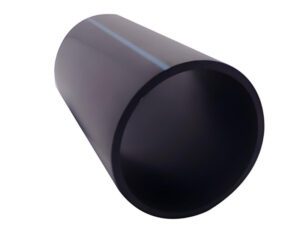 When infrastructure projects demand high flow rates without the space for multiple smaller pipes, engineers turn to large-diameter solutions. The 900mm HDPE pipe (High-Density Polyethylene pipe) represents the perfect balance between massive conveyance capacity and practical handling. At nearly a meter in diameter (900mm = 0.9 meters or approximately 35.4 inches), this pipe size is a workhorse for municipal water transmission, industrial cooling, and major stormwater drainage systems.
But what exactly is a 900mm PE pipe? How does it compare to traditional materials like concrete or ductile iron? And is 900mm considered the largest HDPE pipe size available? In this comprehensive guide, we will answer all these questions and more, providing engineers, contractors, and procurement professionals with everything they need to know about 900mm diameter HDPE pipes.
What is a 900mm HDPE Pipe? (Technical Overview)
A 900mm HDPE pipe refers to a pipe with a nominal outside diameter (OD) of 900 millimeters. It is manufactured by extruding high-density polyethylene resin (typically PE80 or PE100 grade) through a large-diameter die. The result is a lightweight yet incredibly strong pipe that resists corrosion, chemicals, and ground movement.
Basic Specifications at a Glance
| Parameter | Value |
|---|---|
| Outside Diameter (OD) | 900 mm ± 1% |
| Inside Diameter (ID) | Varies by SDR (e.g., SDR 17 ID ≈ 795 mm) |
| Material Grades | PE80 or PE100 (PE100 recommended for pressure applications) |
| Standard Lengths | 6m, 10m, or 12m |
| Color | Black with blue stripes (water) / Solid black (sewage) / Yellow (gas) |
| Manufacturing Standards | ISO 4427, ASTM F714, IS 4984, IS 14333 |
900mm PE Pipe vs. 900mm HDPE Pipe – Is There a Difference?
Technically, there is no difference. "PE pipe" stands for Polyethylene pipe, and "HDPE pipe" stands for High-Density Polyethylene pipe. All HDPE pipes are PE pipes, but not all PE pipes are HDPE (there are also MDPE – Medium Density – pipes). For 900mm diameter applications, the material is almost exclusively HDPE (PE80 or PE100) because of the higher strength requirements.
In common industry usage:
-
900mm PE pipe is a broader term.
-
900mm HDPE pipe specifies the high-density variant, which is what you need for pressure applications, buried installations, and long service life.
Why Choose 900mm Diameter HDPE Pipe Over Traditional Materials?
At 900mm diameter, traditional materials become extremely heavy and difficult to install. Here is how HDPE compares:
| Feature | 900mm HDPE (PE100) | 900mm Concrete (NP3) | 900mm Ductile Iron (DI) | 900mm Mild Steel (MS) |
|---|---|---|---|---|
| Weight per 6m pipe | ~360 kg (SDR 17) | ~3,200 kg | ~2,400 kg | ~2,800 kg |
| Joint type | Butt fusion (leak-proof) | O-ring/gasket | Gasketed push-on | Welded |
| Corrosion resistance | Excellent (immune) | Poor (rebar rusts) | Moderate (needs lining) | Poor (needs coating) |
| Flexibility | High (bends with settlement) | Rigid (cracks) | Moderate | Rigid |
| Hydraulic efficiency (C-factor) | 150 (smooth) | 120-130 | 130-140 | 120 (rusts) |
| 50-year life cycle cost | Lowest | High | Medium-high | Very high |
Key Advantages for 900mm Pipes
-
Lightweight Installation – A 6m length of 900mm HDPE (SDR 17) weighs approximately 360 kg, which can be handled by a medium-sized excavator or a small crane. The same length in concrete weighs nearly 3.2 tons, requiring heavy lifting equipment.
-
Leak-Free Joints – Butt fusion creates a monolithic, fully sealed joint that is as strong as the pipe itself. No gaskets to age or leak.
-
Corrosion Immunity – HDPE does not rust, rot, or chemically react with most soils, acids, or alkalis. No cathodic protection needed.
-
Seismic Resilience – The flexibility of 900mm HDPE pipe allows it to withstand ground settlement, minor earthquakes, and soil movement without cracking.
Key Specifications of 900mm Dia HDPE Pipe (SDR, PN, Weight)
Understanding SDR (Standard Dimension Ratio) is critical when specifying a 900mm dia HDPE pipe. SDR = OD ÷ wall thickness. Lower SDR means thicker wall, higher pressure rating.
Common SDR Ratings for 900mm HDPE Pipe
| SDR | Wall Thickness (mm) | PN Rating (PE100) | Weight per meter (kg) | Typical Application |
|---|---|---|---|---|
| SDR 41 | 22.0 mm | PN 4 | ~24 kg | Gravity sewers, stormwater |
| SDR 33 | 27.3 mm | PN 5 | ~30 kg | Large diameter drainage |
| SDR 26 | 34.6 mm | PN 6 | ~38 kg | Cooling water intakes |
| SDR 21 | 42.9 mm | PN 8 | ~47 kg | Raw water transmission |
| SDR 17 | 52.9 mm | PN 10 | ~58 kg | Municipal water mains |
| SDR 13.6 | 66.2 mm | PN 12.5 | ~73 kg | Industrial process water |
| SDR 11 | 81.8 mm | PN 16 | ~90 kg | High-pressure force mains |
Flow Capacity of 900mm HDPE Pipe
At a flow velocity of 1.5 m/s (typical for water transmission), a 900mm HDPE pipe can carry approximately:
-
ID (SDR 17): 795 mm → Cross-sectional area ≈ 0.496 m² → Flow rate ≈ 744 liters per second (2,678 m³/hour or 2.68 million liters per hour)
This is sufficient for a city of 250,000–300,000 people.
Is 900mm the Largest HDPE Pipe Size?
While 900mm is a large-diameter pipe, it is not the largest HDPE pipe size available. HDPE pipes are manufactured up to 2,500 mm (2.5 meters) and even larger for special applications. The common large sizes include:
| Diameter | Typical Availability | Common Use |
|---|---|---|
| 800 mm | Widely available | Secondary transmission |
| 900 mm | Widely available | Primary transmission |
| 1000 mm (1m) | Available | Major water mains |
| 1200 mm (1.2m) | Special order | Bulk water supply |
| 1400 mm (1.4m) | Limited | Power plant intakes |
| 1600 mm (1.6m) | Very limited | Large irrigation |
| 2000 mm (2m) | Project-specific | Major outfalls |
Verdict: 900mm is considered a large-diameter HDPE pipe, but not the absolute largest. For most municipal and industrial applications, 900mm offers an excellent balance of flow capacity and manufacturing availability.
Critical Applications of 900mm HDPE Pipes
1. Municipal Water Transmission Mains
Cities expanding their water supply networks use 900mm HDPE pipes as primary feeders from treatment plants to storage reservoirs. The smooth bore reduces pumping energy costs by 20–30% compared to concrete or aged steel pipes.
2. Raw Water Intake Lines
Power plants and large industrial facilities draw cooling water from rivers or lakes. A 900mm PE pipe is ideal for submerged intakes because it resists saltwater corrosion and is flexible enough to accommodate wave action.
3. Stormwater Drainage for Large Catchments
With climate change increasing rainfall intensity, urban planners are upsizing stormwater drains. A 900mm diameter HDPE pipe can handle peak flows exceeding 1,500 liters per second (depending on slope).
4. Sewage Force Mains
When sewage cannot flow by gravity, a force main is used. HDPE's resistance to hydrogen sulfide (H₂S) corrosion makes it superior to ductile iron or concrete.
5. Irrigation Scheme Backbones
Under the Pradhan Mantri Krishi Sinchayee Yojana (PMKSY), large-diameter HDPE pipes are replacing open canals to prevent water loss from seepage and evaporation.
Manufacturing Process for 900mm HDPE Pipes
Producing a 900mm dia HDPE pipe requires specialized equipment:
Step 1: Raw Material Drying
Virgin PE100 resin (often with 2–2.5% carbon black for UV protection) is dried to remove moisture.
Step 2: Extrusion
The resin is melted in a large extruder (typically 150–200 kW motor) and forced through a spiral or spider die that shapes the 900mm diameter.
Step 3: Sizing & Cooling
The extruded pipe passes through a vacuum calibration tank (8–10 meters long) that sets the outer diameter. Then it moves through a cooling bath (20–30 meters) to solidify the pipe uniformly.
Step 4: Haul-Off & Cutting
A caterpillar haul-off pulls the pipe at a controlled speed. An automatic saw cuts the pipe to specified lengths (6m, 10m, or 12m).
Step 5: Marking & Coiling/Stacking
The pipe is printed with manufacturer details, standard, SDR, and running meter length. Pipes are either stacked (for rigid lengths) or coiled (for smaller SDRs).
Quality Control & Testing Standards
Every 900mm HDPE pipe from a reputable manufacturer undergoes:
| Test | Standard | Acceptance Criteria |
|---|---|---|
| Hydrostatic pressure test | ISO 4427 | 1.5× PN for 100 hours, no failure |
| Melt Flow Index (MFI) | ISO 1133 | 0.6–1.2 g/10 min |
| Oxidation Induction Time (OIT) | ISO 11357 | ≥20 minutes at 200°C |
| Carbon black dispersion | IS 12615 | Grade 1 or 2 |
| Wall thickness (ultrasonic) | Continuous | ±10% of nominal |
| Ovality | Manual measurement | ≤5% |
Installation Best Practices for 900mm Pipes
Trench Preparation
| Parameter | Requirement |
|---|---|
| Trench width | OD + 500 mm (1.4 m for 900mm pipe) |
| Depth | Minimum 1,000 mm to top of pipe |
| Bedding | 150 mm of compacted sand (no stones >10 mm) |
Handling & Lifting
-
Use nylon or polyester slings (minimum 2–3 ton capacity)
-
Never use chains – they gouge HDPE
-
For 12m lengths, use three lifting points
Butt Fusion Parameters (PE100, SDR 17)
| Parameter | Value |
|---|---|
| Heater plate temperature | 210°C ± 5°C |
| Heating time | 12–18 minutes (depending on wall thickness) |
| Changeover time | <60 seconds |
| Cooling time | 30–45 minutes |
Backfilling
| Layer | Material | Thickness |
|---|---|---|
| 1 (surround) | Sand | 200 mm above pipe |
| 2 (warning) | Sand + detectable tape | 150 mm |
| 3 (primary) | Native soil (no rocks >50 mm) | To surface |
Cost Factors & Pricing Estimation (Indian Market)
| SDR | PN Rating | Approximate Price per Meter (₹) | Price per 6m Pipe (₹) |
|---|---|---|---|
| SDR 41 | PN 4 | ₹5,500 – ₹6,500 | ₹33,000 – ₹39,000 |
| SDR 33 | PN 5 | ₹6,500 – ₹7,800 | ₹39,000 – ₹46,800 |
| SDR 26 | PN 6 | ₹7,800 – ₹9,500 | ₹46,800 – ₹57,000 |
| SDR 21 | PN 8 | ₹9,500 – ₹11,500 | ₹57,000 – ₹69,000 |
| SDR 17 | PN 10 | ₹11,500 – ₹14,000 | ₹69,000 – ₹84,000 |
| SDR 13.6 | PN 12.5 | ₹14,000 – ₹17,500 | ₹84,000 – ₹1,05,000 |
| SDR 11 | PN 16 | ₹17,500 – ₹22,000 | ₹1,05,000 – ₹1,32,000 |
*Prices are indicative, ex-factory, exclusive of GST (18%). Resin cost volatility affects pricing.*
Why Choose Us as Your 900mm HDPE Pipe Manufacturer?
-
Dedicated Large-Diameter Line – We maintain extrusion dies for 900mm OD across all SDRs (SDR 11 to SDR 41).
-
Virgin PE100 Resin – Full traceability to global suppliers (SABIC, Borealis, or equivalent).
-
100% Quality Testing – Ultrasonic wall thickness on every meter, hydrostatic testing per batch.
-
Pan-India Delivery – Low-bed trailers arranged; we handle logistics to your site.
-
Onsite Technical Support – Fusion training, jointing supervision, and installation guidance.
Frequently Asked Questions (FAQ)
Q1: What is the difference between 900mm HDPE pipe and 900mm PE pipe?
A: No practical difference. "HDPE" specifies high-density grade, which is what you need for buried pressure applications.
Q2: Is 900mm the largest HDPE pipe size available?
A: No. HDPE pipes are manufactured up to 2,500 mm (2.5 meters). 900mm is considered large, but not the maximum.
Q3: Can 900mm HDPE pipe be used for gas transmission?
A: Yes, but only with yellow color coding and compliance with ISO 4437 (gas-specific standard).
Q4: What is the expected service life of a 900mm HDPE pipe?
A: For PE100 under continuous pressure (PN rating), design life is 50 years. For gravity/non-pressure applications, 100+ years.
Q5: How is a 900mm HDPE pipe repaired if damaged?
A: Small damage – electrofusion patch. Large damage – cut out the damaged section and butt-fuse a new piece with two couplings.
Conclusion
The 900mm HDPE pipe (also referred to as 900mm PE pipe or 900mm diameter HDPE pipe) is a versatile, cost-effective, and durable solution for large-scale water conveyance, stormwater drainage, and industrial applications. While it is not the largest HDPE pipe size available, it strikes an excellent balance between flow capacity (over 700 liters per second) and practical handling (360 kg per 6m length). Its corrosion resistance, leak-proof fusion joints, and 50+ year service life make it superior to concrete, ductile iron, and steel for most buried applications.
Whether you are designing a municipal water main, an industrial cooling water intake, or a major irrigation backbone, specifying a 900mm dia HDPE pipe from a reputable manufacturer ensures reliability, low maintenance, and excellent life-cycle value.
Ready to source 900mm HDPE pipes for your next project? Contact our engineering team for technical datasheets, a competitive quotation, and a site visit to discuss your specific requirements.